We may earn a commission when you buy through links on this page, at no extra cost to you; see our Affiliate Disclosure.
Snoring is very common, and it can disturb whoever is sleeping with you. A snoring chin strap is a simple, soft band that helps keep your mouth closed while you sleep. Chin straps are not a proven way to stop snoring, and they do not treat sleep apnea; they are mainly used as a CPAP accessory. We prepared a buying guide in case you want to try one.Disclaimer: This article is for general information and is not medical advice. A chin strap does not cure snoring or treat sleep apnea. If you snore loudly, have pauses in your breathing, choke or gasp in your sleep, or feel very sleepy in the day, see a doctor.[1][2]

Key Specs Compared
Numbers match the reviews below (tap to jump).
| # | Design | Material | Latex-free | Sizes | Made in USA |
|---|---|---|---|---|---|
| 1 | Halo, adjustable | Breathable fabric | Yes (maker claim) | Regular | Yes (maker claim) |
| 2 | Halo, adjustable | Breathable fabric | Yes (maker claim) | Fits different head sizes | Not stated |
| 3 | 2 hook-and-loop straps | Neoprene | Not stated | One size | Not stated |
| 4 | 2 adjustable straps | Neoprene with air holes | Not stated | S, M, L | Not stated (engineered in California) |
✓ yes · ✗ no · – not confirmed · Specs as stated on the Amazon listing or by the maker · Not a treatment for any condition
Before you buy
- Loud snoring can be a sign of sleep apnea. The American Academy of Sleep Medicine says snoring is likely to be a sign of sleep apnea when it comes with silent breathing pauses and choking or gasping sounds.[2]
- A chin strap alone is not a treatment for sleep apnea. In a 2014 study, a chin strap on its own did not improve sleep apnea, even in mild cases.[3]
- A strap may hide the warning sign. Quieter snoring with a strap does not mean sleep apnea is gone. If you snore and also gasp or choke in your sleep, or feel very sleepy in the day, ask a doctor about a sleep study or home sleep apnea test.[2]
- Using CPAP? Mayo Clinic says a chin strap may help keep your mouth closed and reduce air leaks if you wear a nasal mask.[4] Ask your sleep doctor or equipment supplier whether one suits your mask. Do not replace CPAP with a chin strap.[5]
- Blocked nose: a chin strap pushes you to breathe through your nose. A 2025 review noted that keeping the mouth closed by tape or a chin strap could be dangerous if the nose is seriously blocked.[6] Don’t wear one with a blocked nose, and stop if it makes breathing hard.
Why People Use Snoring Chin Straps
Here are some reasons people choose these simple devices, and what to keep in mind.- Mouth Closed – Apply the chin strap as instructed. It holds the jaw so your mouth stays closed. For CPAP users with a nasal mask, this may reduce air leaking from the mouth.[4] On its own, a chin strap did not improve snoring in a study of people with sleep apnea.[3]
- Affordable – Just like sound machines for sleep, these devices are usually inexpensive.
- Easy to Carry – You can take a chin strap anywhere; most fit easily in a pocket or travel bag.
- Soft – Chin straps are made from light, soft material so they don’t feel harsh on your skin.
What the Research Says
- About 40 percent of adult men and 24 percent of adult women snore regularly. Sleeping on your back, alcohol and a blocked nose can make it more likely.[1]
- The AASM says conservative steps should be encouraged for everyone who snores: avoiding alcohol before bed, stopping smoking, losing weight and sleeping on your side.[1]
- In a 2014 study of 26 adults with obstructive sleep apnea, a chin strap alone did not improve breathing during sleep, even in the 13 mild cases, and did not improve snoring. CPAP did. The authors concluded a chin strap alone is not an effective treatment for sleep apnea.[3]
Types of Snoring Chin Straps
There are several types of chin straps available. Here are the common ones:- Cotton – Cotton chin straps are usually soft and comfortable, but they don’t grip as firmly as others.
- Polyester and Neoprene – These are slightly more rigid and give a firmer grip. If you have a latex allergy, look for a strap labeled latex-free.
- Synthetic Blends – Usually the cheapest. They offer decent comfort and grip but can feel sweaty during long use.
- Adjustable – Many straps have adjustable bands and hook-and-loop fastening. Halo-style straps, a ring around the head with a chin cup, stay in place better for some people.
Buying Considerations for Snoring Chin Straps
Consider the following factors before getting a snoring chin strap.- Fabric – Some fabrics are more comfortable, while others give better support. Consider what you need.
- Fit – While most chin straps are adjustable, pick one that fits your head shape and size. It should not press on your throat.
- Adjustment – Some bands have multiple adjustable straps for a better fit. If you use CPAP, check that the strap works with your mask.[4]
How we chose these chin straps
We did not test these products ourselves. We compared them using the research steps on our How We Research page:- Style and materials: taken from the maker’s listing.
- Recall check: we searched the CPSC recall database for each brand and for chin straps.[7]
- Availability: each product was listed as in stock on Amazon when we last checked (October 2026).
Reviews: Snoring Chin Straps
1


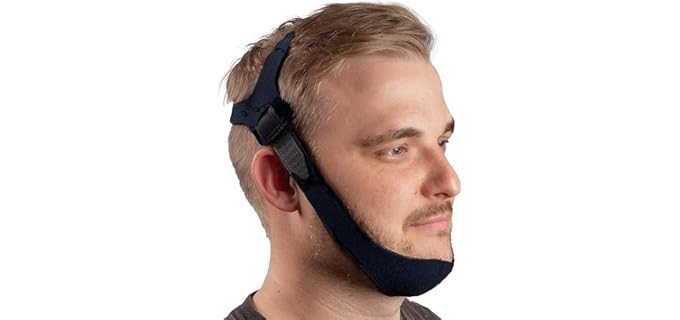
- Best for: CPAP users who want a halo strap that wraps around the head.
- The straps are adjustable for different head sizes.
- The maker says it is latex-free and made in the USA. The listing says it reduces snoring; evidence for chin straps alone doesn’t support that.[3]
2


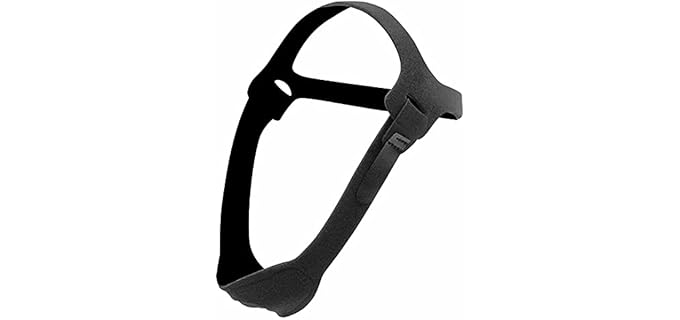
- Best for: a simple halo strap with a chin support.
- The maker says it fits different head sizes, is easily adjustable and is made of breathable, latex-free fabric. The listing, under the Sunset Healthcare name, describes it as a CPAP mask accessory.
3


- Best for: a light two-strap design.
- It has two adjustable hook-and-loop straps; the upper strap has a buckle and can be trimmed to length.
- The maker says it is made of neoprene fabric and comes in one size. The listing doesn’t say whether it is latex-free. It calls the strap a snoring device that “actually works”; the 2014 study found a chin strap alone didn’t improve snoring.[3]
4


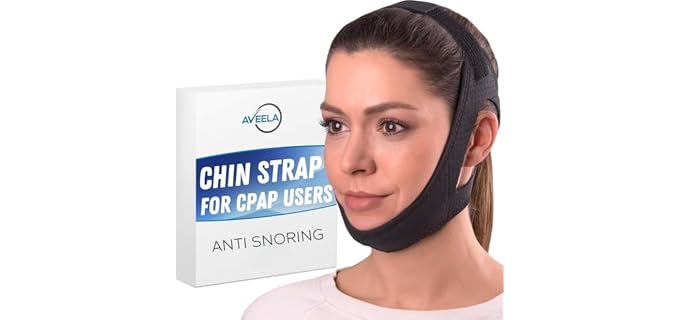
- Best for: people who want to choose a size rather than rely on one size fits all.
- It has two adjustable straps and is sold in small, medium and large, in black or gray.
- The maker says it is made of neoprene with air holes, and recommends hand washing. It says it was engineered in California but doesn’t say where it is made, or whether it is latex-free. The listing title calls it a “jaw strap for sleep apnea”; a chin strap alone is not a sleep apnea treatment.[3]
Frequently Asked Questions
- Do chin straps stop snoring? There is little evidence that they do. In a 2014 study of adults with sleep apnea, a chin strap alone did not improve snoring or breathing during sleep. If you snore loudly, see a doctor.
- When is snoring a reason to see a doctor? See a doctor if you snore loudly, have pauses in your breathing, choke or gasp in your sleep, or are often tired in the day. These can be signs of sleep apnea, which needs a diagnosis and treatment.
- Can I use a chin strap with CPAP? Some CPAP users wear one to help keep the mouth closed. Ask your sleep doctor or equipment supplier whether it suits your mask.
Index Table: Snoring Chin Straps
| No. | Product | Image | Features | Brand |
|---|---|---|---|---|
| 1 | LifeSource Halo Chin Strap - Adjustable Latex-Free Halo Style Chin Strap |  |
| LifeSource |
| 2 | BreatheWear Halo Chinstrap - Adjustable Halo Style Chin Support Strap |  |
| BreatheWear |
| 3 | Sleep Legends Adjustable Strap - Two-Strap Neoprene Adjustable Chin Strap |  |
| Sleep Legends |
| 4 | AVEELA Adjustable Chin Strap - Two-Strap Neoprene Chin Strap, Three Sizes |  |
| AVEELA |
Sources
- American Academy of Sleep Medicine, Sleep Education. Snoring. Accessed October 14, 2026.
- American Academy of Sleep Medicine, Sleep Education. Obstructive Sleep Apnea. Accessed October 14, 2026.
- Bhat S, et al. The Efficacy of a Chinstrap in Treating Sleep Disordered Breathing and Snoring. J Clin Sleep Med. 2014;10(8):887-892. PMID 25126035. Accessed October 14, 2026.
- Mayo Clinic. CPAP machines: Tips for avoiding 10 common problems. Accessed October 17, 2026.
- American Academy of Sleep Medicine, Sleep Education. CPAP. Accessed October 14, 2026.
- Rhee J, et al. Breaking social media fads and uncovering the safety and efficacy of mouth taping in patients with mouth breathing, sleep disordered breathing, or obstructive sleep apnea: A systematic review. PLoS One. 2025;20(5):e0323643. Accessed October 17, 2026.
- U.S. Consumer Product Safety Commission. Recalls. Accessed October 14, 2026.
Update History
- Oct 2026: Added Mayo Clinic as the source for chin strap use with nasal CPAP masks; added a blocked-nose caution from a 2025 review; stated that a chin strap alone is not a sleep apnea treatment; noted listing snoring and sleep apnea claims the evidence does not support; filled the latex-free and Made in USA cells; renumbered citations in order of use; added Sources (Mayo Clinic, PLoS One)
- Oct 2026: Product picks reviewed and updated; added a Key Specs table; added Sources (AASM Sleep Education, PubMed Central, CPSC)
- Feb 2022: Added Sleep Legends Adjustable Chin Strap
- Sep 2020: First published
