We may earn a commission when you buy through links on this page, at no extra cost to you; see our Affiliate Disclosure.
Bunkie boards are useful bed accessories. They give your mattress a flat, even surface, which can help keep it from sagging between slats. Bunkie boards also provide a low-profile foundation for your mattress. Most bunkie boards feature steel or solid wood frames with slats and fabric. But finding the right one is never easy. So we shared our bunkie board reviews to save you from the hassle of endless scrolling and browsing. Have a look!
Key Specs Compared
Numbers match the reviews below (tap to jump).
| # | Build | Thickness | Split or fold | Assembly | Warranty |
|---|---|---|---|---|---|
| 1 | Steel frame, wood slats | 1.6" | Neither (one piece) | Easy assembly | 5-yr warranty |
| 2 | Solid pine slats | 0.75" | Not stated | Pre-assembled | No warranty |
| 3 | Split wood, fabric cover | 1.5" | 2-piece split | Fully assembled | Not stated |
| 4 | Twin-wall core, fabric cover | 0.4" | Folding | None needed | Not stated |
| 5 | Pine plywood | 0.4" | Folding | None needed | Not stated |
✓ yes · ✗ no · – not confirmed · Specs as stated on the Amazon listing or by the maker · Not a treatment for any condition
Benefits of Bunkie Boards
Bunkie boards are more than furniture; they offer several benefits. Here are the top ones.- Strong and Robust Support – Bunkie boards give the mattress a flat surface and can cut down on squeaks from slats.
- Low Profile Bedding – Since bunkie boards are thin, they keep the mattress low, which is ideal for kids and the elderly.
- Lightweight – Bunkie boards are a good option to keep the bed’s weight on the lower side of the scale. They’re also easy to assemble and carry.
What to Look For in Bunkie Boards?
While all bunkie boards look alike, they’re not really similar. So here are a few things to look for when you buy to avoid disappointing returns.
- Noise-free – Beds that squeak for any reason never allow for a peaceful night. So look for bunkie boards covered in fabric. Plus, slightly quilted boards with slip-proof tape make no noise.
- Durability – Especially when choosing a wooden board, make sure the slats can support a lot of weight.
- Size and Fitting – Just like choosing the size of a mosquito net for a bed, the bunkie board must be the right size to fit your bed frame and sit beneath your mattress. They are also compatible with most mattresses, so that shouldn’t be a concern.
Bunkie Boards Versus Box Springs
Bunkie Boards and Box Springs are cunning competitors when choosing a bed foundation. Here’s a brief comparison of the two.- Height – Most bunkie boards are under 2 inches tall. Box springs are much taller, often around 9 inches.
- Weight – Bunkie boards are usually much lighter than box springs. Weight varies by material and size.
- Mattress Type – Bunkie boards suit most mattresses, while box springs are designed for spring mattresses.
- Price – Bunkie boards are much cheaper than box springs. However, box springs may prove to be much more durable than bunkie boards.
Frequently Asked Questions (FAQ) on Bunkie Boards
- Can you use plywood as a bunkie board If you want to make your own bunkie board, place a firm piece of plywood beneath your mattress. The plywood should be at least 3/4 inch thick and fit your bed well.
- What is the purpose of a bunkie board? A bunkie board provides a supporting surface to prevent sagging. Bunkie boards were originally used with bunk beds because a box spring would have raised the mattress too high.
- Do I really need a bunkie board? Bunkie boards, despite their simplicity, matter for any low-profile bed where you don’t want to add the height of a box spring, or when clearance is an issue and a box spring isn’t possible. Platform beds, daybeds, trundles, bunk beds, and lofts can all use it instead of a box spring.
- Are bunkie boards solid wood? A bunkie board is a solid platform that supports the mattress and attaches to a bed frame or sits on top of a slatted bed base. Bunkie boards come in a variety of thicknesses, from under half an inch to about 3 inches. The thickness depends on your bed type and how much height you want to add.
Our Picks: Bunkie Boards
Below are some bunkie boards available online. We hope you love the bunkie boards we recommend!1


- This 1.6-inch bunkie board has a steel frame with wood slats.
- Foam and tape on the frame keep it quiet, and anti-slip tape holds the mattress in place.
- It ships in a compact package and is easy to assemble.
- It has a 5-year limited warranty.
2


- These heavy-duty slats are made from solid Southern Yellow Pine.
- They come pre-assembled and rest on your frame rails; no tools are needed.
- The maker notes they reinforce a frame but do not repair broken frames or worn mattresses.
- The wood comes from SFI certified sourcing.
3


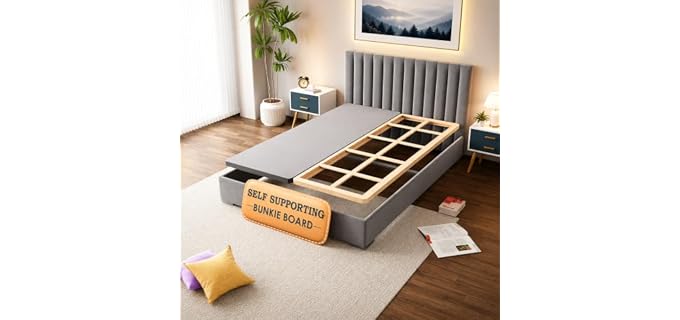
- This 1.5-inch bunkie board is made from split wood with a slatted design and a stitched fabric cover.
- It comes in two halves for easier handling.
- It arrives fully assembled.
- It works on slatted beds, bunk beds, loft beds and daybeds, per the listing.
4


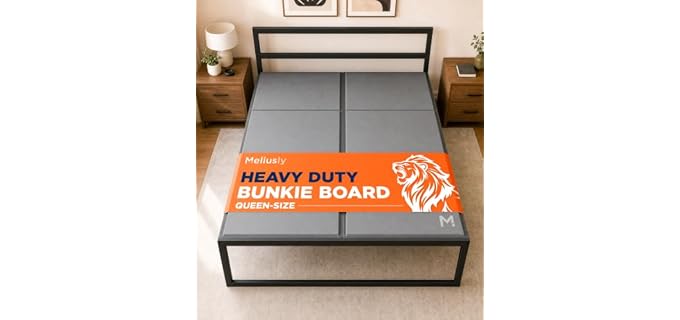
- This bunkie board is just 0.4 inches thick, so it won’t change your bed height.
- An Oxford fabric cover reduces creaking, and a silicone grip keeps it from sliding.
- It works on frames with slats or bars spaced up to 10 inches apart.
- It unfolds flat and sets up in about a minute with no tools.
5


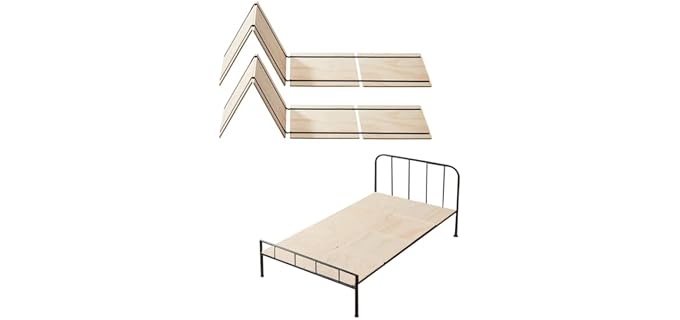
- This twin bunkie board is made from 0.4-inch pine plywood panels.
- Sturdy straps connect the panels, and the gaps between them let air through.
- It folds for storage and needs no assembly.
- Back support claims on the listing are the maker’s, not ours.
Index Table: Top-Rated Bunkie Boards
| No. | Product | Image | Features | Brand |
|---|---|---|---|---|
| 1 | Zinus Deepak 1.6-Inch - Metal Frame Wood Slat Bunkie Board |  |
| Zinus |
| 2 | Hercules Xtreme Slats - Heavy Duty Solid Pine Bed Slats |  |
| Hercules |
| 3 | Zayton Split 1.5-Inch - Fully Assembled Split Wood Bunkie Board |  |
| Zayton |
| 4 | Meliusly Heavy Duty - Low Profile Bunkie Board Support |  |
| Meliusly |
| 5 | VEVOR Foldable Board - Foldable Wooden Bunkie Board Twin |  |
| VEVOR |
Update History
- Oct 2026: Product picks reviewed and updated; added a Key Specs table
- Sep 2020: Added Hercules Xtreme Heavy-Duty Bed Slats
- Feb 2020: First published
